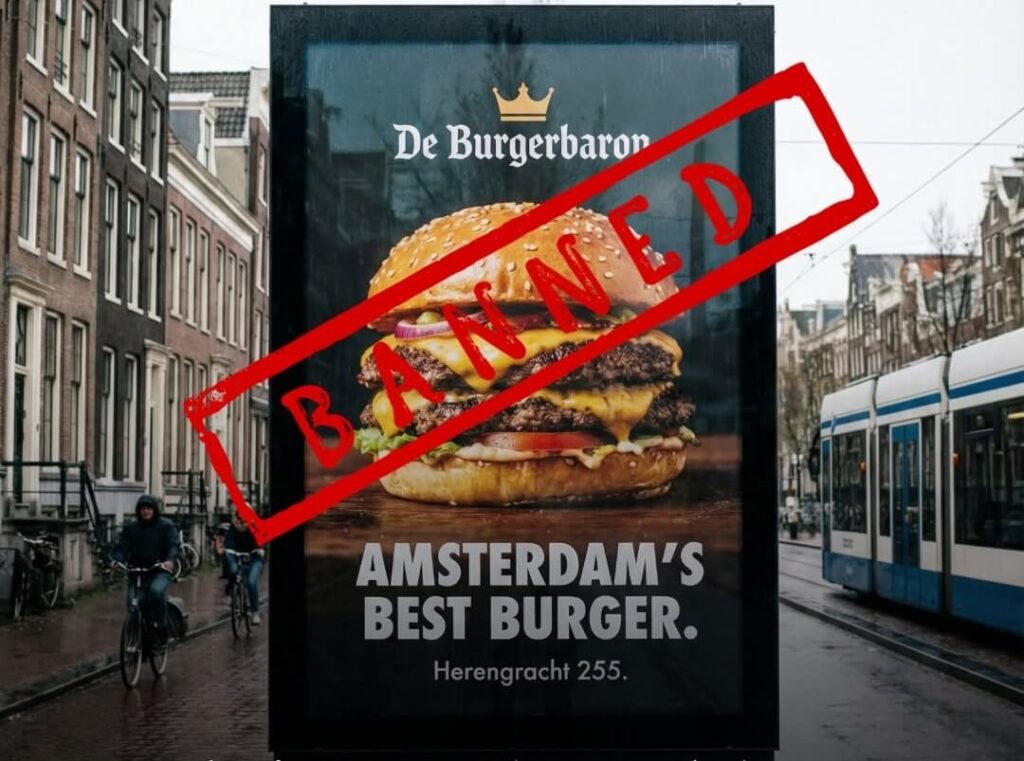
No More Meat Advertising on the Streets of Amsterdam
From May onwards, it will no longer be irrelevant what kind of advertisement flashes up at an Amsterdam bus stop or on a billboard. The Dutch capital is introducing a new regulation that strongly restricts the advertising of animal-based products and fossil fuels in public spaces. This is an advertising restriction “related to climate protection.” What does NÉGYOSZ think about this? Read on for the details!
What exactly is Amsterdam banning?
According to the city council’s regulation, which will come into force on May 1, 2026:
There will be no more outdoor advertising for meat products or fossil fuels on street billboards, at bus stops, or on other public advertising surfaces. The ban does not apply to shop windows or businesses’ own local promotions, meaning that producers and retailers may still promote their goods — just not everywhere.
This step reflects the fact that more and more decision-makers are recognizing that the “visibility” of environmentally harmful products not only influences consumer choices, but also shapes social norms. Advertising does not merely inform — it often determines what is considered “normal” or desirable.
According to the political justification, the food system is responsible for roughly one-third of global greenhouse gas emissions, and within this, the environmental burden of animal-based products is significantly higher than that of plant-based ones. This approach fits well with international climate protection goals, which state that radical changes in food consumption habits are necessary if we want to achieve the carbon neutrality target set for 2050.
Not only Amsterdam
In the Netherlands, several cities had already implemented certain similar advertising restrictions back in 2024, but Amsterdam is the first capital city in the world to introduce this through legislation in a targeted way, extending it to meat as well.
This step carries a clear message
- Communication in public spaces comes with responsibility, and the role of city decision-makers goes beyond merely selling advertising surfaces.
- Visibility matters: if people mostly encounter advertisements for highly polluting products, it reinforces the consumption patterns that science says should be reduced.
- Positioning plant-based foods in public discourse is relevant not only from a health perspective, but also from a climate protection standpoint.
Why is this important for Hungary as well?
In Hungary, where there is still much to do to strengthen the production and consumption of plant-based foods, it would be useful to initiate a dialogue about how local decision-makers could make public-space communication more effective in order to help shift public opinion toward more sustainable and healthier habits.
Amsterdam’s step also emphasizes that advertising is a tool for shaping social norms. What we see on city streets influences societal priorities and reinforces certain messages.
The result of this regulation is not only that posters offering bacon, fast-food hamburgers, and raw meat from supermarket chains will disappear, but also that companies offering plant-based alternatives will gain new opportunities — as shown, for example, on this poster in Haarlem. (In Haarlem, this regulation has been in place since 2022.)
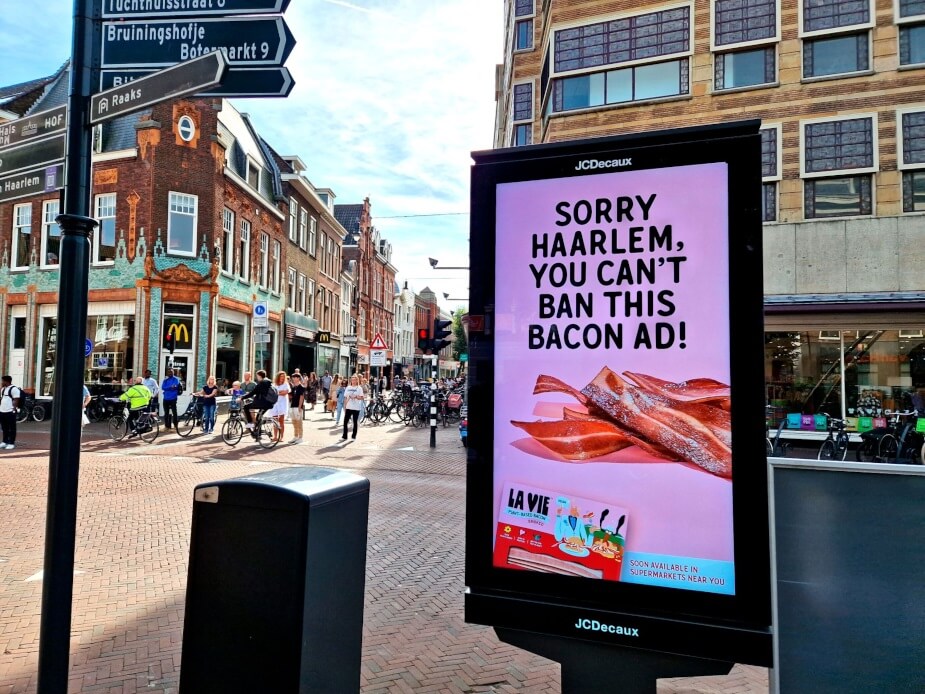
According to NÉGYOSZ’s position, increasing the visibility of plant-based foods is not only a market interest, but also a social and environmental one. Although approaches may differ across European countries, encouraging the expansion of plant-based foods is necessary, adapted to local opportunities and conditions.
If you are also committed to plant-based foods and the plant-based transition, and you have not yet signed our Manifesto, then now is the time. Click the link!
(Source of the featured image: amsterdam.explores Instagram)