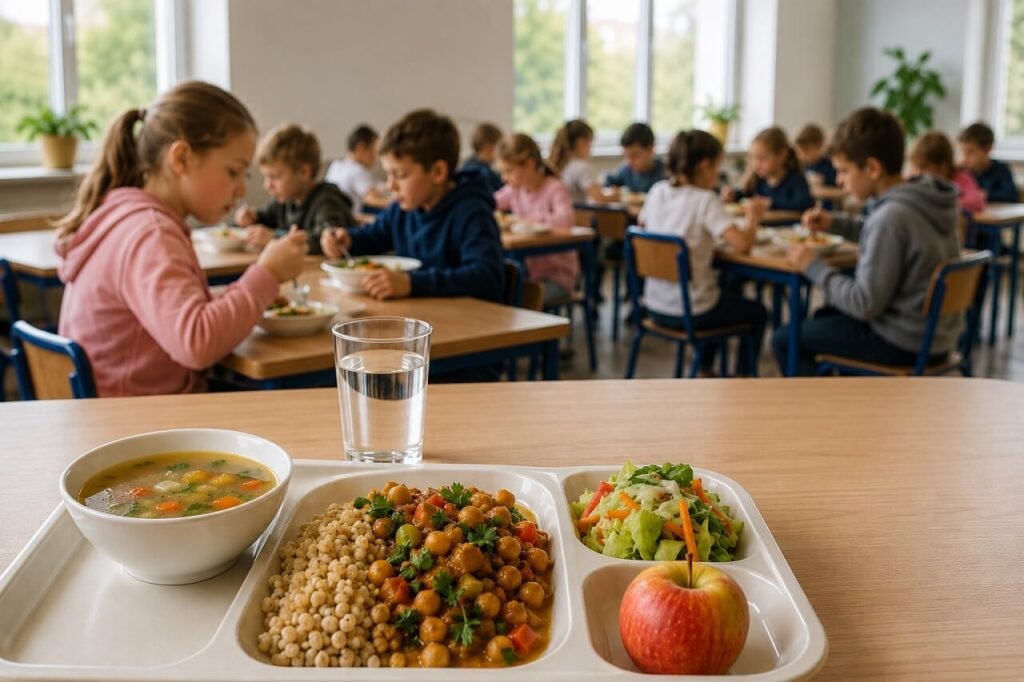
A Turning Point for Public Catering in Poland
Over the past two years, Poland has made significant progress towards transforming its public catering system. As a result, new legal requirements governing catering services in kindergartens, schools and healthcare institutions were signed and officially promulgated in February 2026. They will enter into force on 1 September 2026, the first day of the new school year.
Change Is Possible Even with Similar Food Traditions
Poland’s culinary traditions are similar to Hungary’s in many respects: eating habits in both countries are largely characterised by the dominance of meat-based dishes. This is precisely what makes the Polish experience particularly relevant to us. Despite having a food culture comparable to Hungary’s, Poland has succeeded in introducing a reform that expands plant-based options in public catering.
As part of the preparatory work, professional organisations assessed the composition of school menus across the country. The survey found that menus dominated by meat-based dishes offered children limited variety, both in terms of dietary choices and ingredients. According to experts, this pattern may be linked to the growing prevalence of overweight among children and young people.
Extensive Professional and Public Consultation
The new requirements did not emerge without prior groundwork. In response to pressure from professional and civil society organisations, the Polish Ministry of Health launched a public consultation on school catering regulations in June 2025. The process attracted considerable interest from both the public and professionals, generating more than 800 responses.
After reviewing the submitted proposals, the Ministry committed to changes in four key areas:
- Plant-Based Alternatives for Main Meals
On days when meat or fish is served, both kindergartens and schools must also provide a plant-based alternative, preferably based on legumes. - No Exceptions
The obligation to provide a plant-based alternative applies to every institution, including those where children are served lunch only. - The Option to Replace Dairy Products
Both of the children’s daily servings of dairy products may be replaced with plant-based alternatives. - Consistent Terminology
To ensure clear and consistent implementation, the legislation uses the term “plant-based alternatives to dairy products”.
The new regulation is based on the guidance of the EAT–Lancet Planetary Health Diet, one of the most widely cited scientific recommendations and frameworks for sustainable diets.
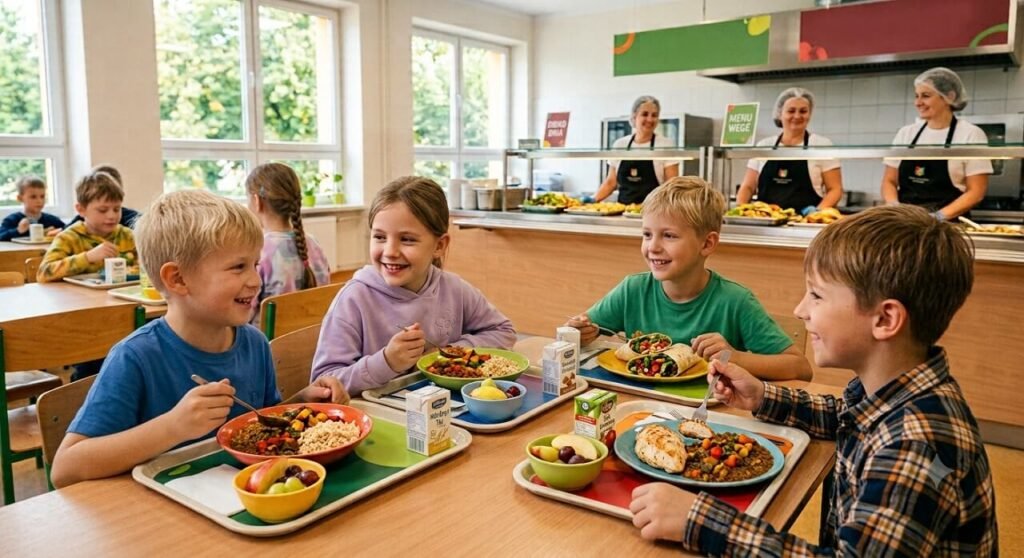
What a Week of School Lunches Will Look Like Under the New Rules
The new requirements establish a specific weekly framework for school lunches:
| Day | Lunch |
| Day 1 | A fully plant-based lunch containing legumes, such as lentils, beans or peas |
| Days 2–3 | A dish made with fresh meat or fish, with a mandatory plant-based alternative |
| Day 4 | A fish dish, with a plant-based alternative |
| Day 5 | A menu of the institution’s choice, without meat |
At least twice a week, the soup selection must include a genuinely vegetable-based soup. Every meal must be accompanied by raw vegetables or fruit, while greater emphasis must be placed on whole-food ingredients and plant-based fats.
The legislation attaches particular importance to the diversity of plant-based ingredients. In addition to legumes, it encourages the use of whole grains, seeds, and seasonal, locally or organically grown fruit and vegetables. Plant-based milk alternatives must be low in sugar and fortified with vitamins and minerals.
What the Reform Is Expected to Achieve
The legislation pursues both public-health and environmental objectives by promoting a more plant-rich diet in institutional catering.
Reducing food waste is another key priority. To achieve this, the requirements recommend practical measures for schools, such as providing age-appropriate portions, making meals more visually appealing and increasing the number of one-course lunches. The legislation also emphasises the importance of monitoring the amount of waste generated and taking students’ needs and preferences into account.
According to the Ministry of Health, the successful implementation of the reform will require the development of school curricula and educational activities introducing healthy and planet-friendly diets. Both theoretical and practical training will also be needed for school staff and public catering providers, covering food preparation, menu planning and recipe development.
Why Is This Relevant to Hungary?
Public catering plays a role in shaping social norms everywhere in the world. In Hungary, approximately 1.5–2 million people eat meals provided through public catering every day. Its influence therefore reaches a vast number of people and, through them, countless families—from children at nursery and kindergarten age to older generations.
Food systems have an enormous role to play in addressing environmental problems, the climate crisis and public-health challenges. Hungary and Poland have similar agricultural, cultural and climatic conditions, making developments in Poland particularly relevant for us.
At NÉGYOSZ, we are working to ensure that Hungarian legislation can keep pace with these changes and that a similar reform can also be introduced in Hungary. This is in the interest of society as a whole and would make a significant positive contribution to addressing both environmental and public-health challenges.
(Illustration: ChatGPT, Gemini)