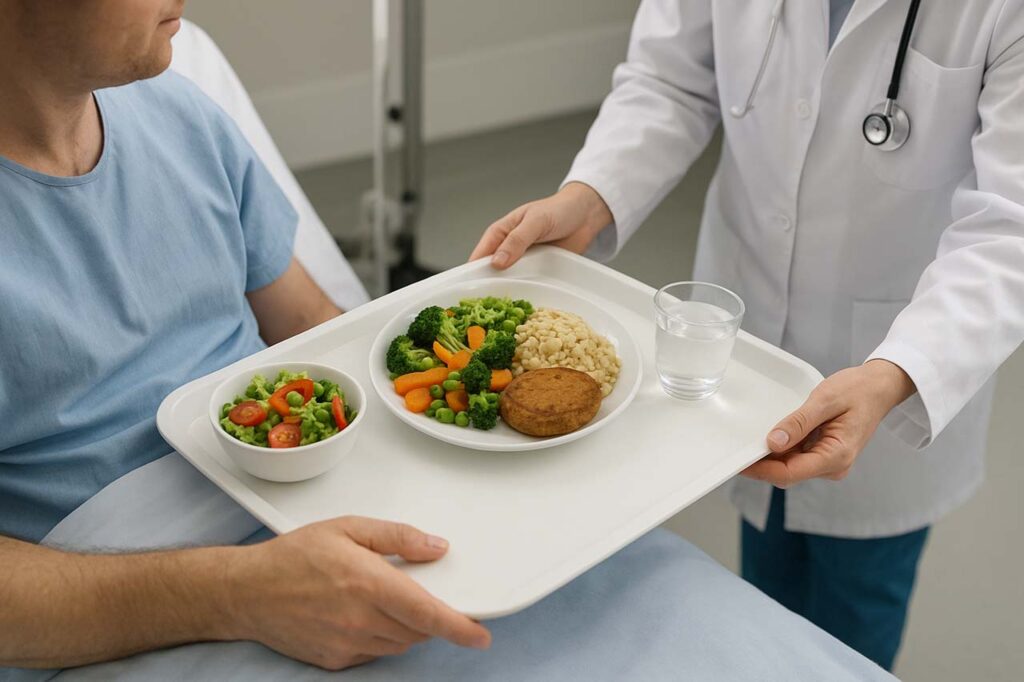
Important step forward in providing plant-based meals in hospitals
Since its establishment, NÉGYOSZ has considered it a priority to make plant-based foods available in public catering, including hospitals and prisons. In recent years, numerous professional consultations, training courses, and legislative preparatory work have taken place in this area. This persistent work has now yielded tangible results: plant-based meals can now be requested and obtained in inpatient care. However, it is worth knowing the details:
The result of long professional work
Decree 37/2014 (IV.30.) EMMI on public catering, amended on November 11, 2024, entered into force on February 9, 2025. Several organizations were involved in preparing for the change: NÉGYOSZ, MAVEG, and MOTE worked together to ensure that the legislative amendment to the law on public catering would be implemented in a way that would not cause problems for the catering industry. Several organizations were involved in preparing the change: NÉGYOSZ, MAVEG (Hungarian Vegan Association), and MOTE (Hungarian Society of Preventive and Lifestyle Medicine) worked together to ensure that the amendment to the legislation also responded to the needs of those on a plant-based diet. The project was led by Ervin Nagy, president of NÉGYOSZ, with a second opinion provided by dietitian Szilvia Magyarvári and support from researchers at the Faculty of Nutrition Sciences at the University of Pécs.
So far, the legal background has been settled. The next step is for hospitals to prepare in practice to care for patients on plant-based diets, whether for dietary or ethical reasons.
What does the amendment to the public catering regulation mean in practice?
Under the regulation, hospitals are now required to provide plant-based diets if requested by patients for medical reasons. This means that if the attending physician or a specialist specified in the regulation prescribes a plant-based diet, the institution must provide it—if this is not possible in-house, it may even be ordered from an external caterer.
This was confirmed by the NNGYK (National Public Health and Pharmaceutical Center) in its written response to our organization’s inquiry:
“If the attending physician – the specialist specified in Section 2 (1) 22 of the Regulation – prescribes a plant-based diet for health reasons, then this is a dietary requirement certified by a specialist, which must be provided during inpatient care.”
This is therefore a clear step forward: the hospital must provide a plant-based diet requested on medical grounds. But what if we want to request a plant-based diet during our stay in hospital on ethical or lifestyle grounds?
It can be requested on ethical or lifestyle grounds, but it is not mandatory to provide it
A plant-based diet requested for lifestyle or ethical, moral, or ideological reasons is still not considered a dietary diet under the regulation, so it is not mandatory to provide it. At the same time, the law does not prohibit hospitals and public caterers from agreeing on this – so if the institution is open to it, it is possible to provide plant-based food.
In summary:
1. Plant-based diets must be provided for medical reasons, even if this requires an external service provider.
2. Plant-based diets are not mandatory for ethical/lifestyle reasons, but they are possible if the patient, the hospital, and, where applicable, the external service provider agree.
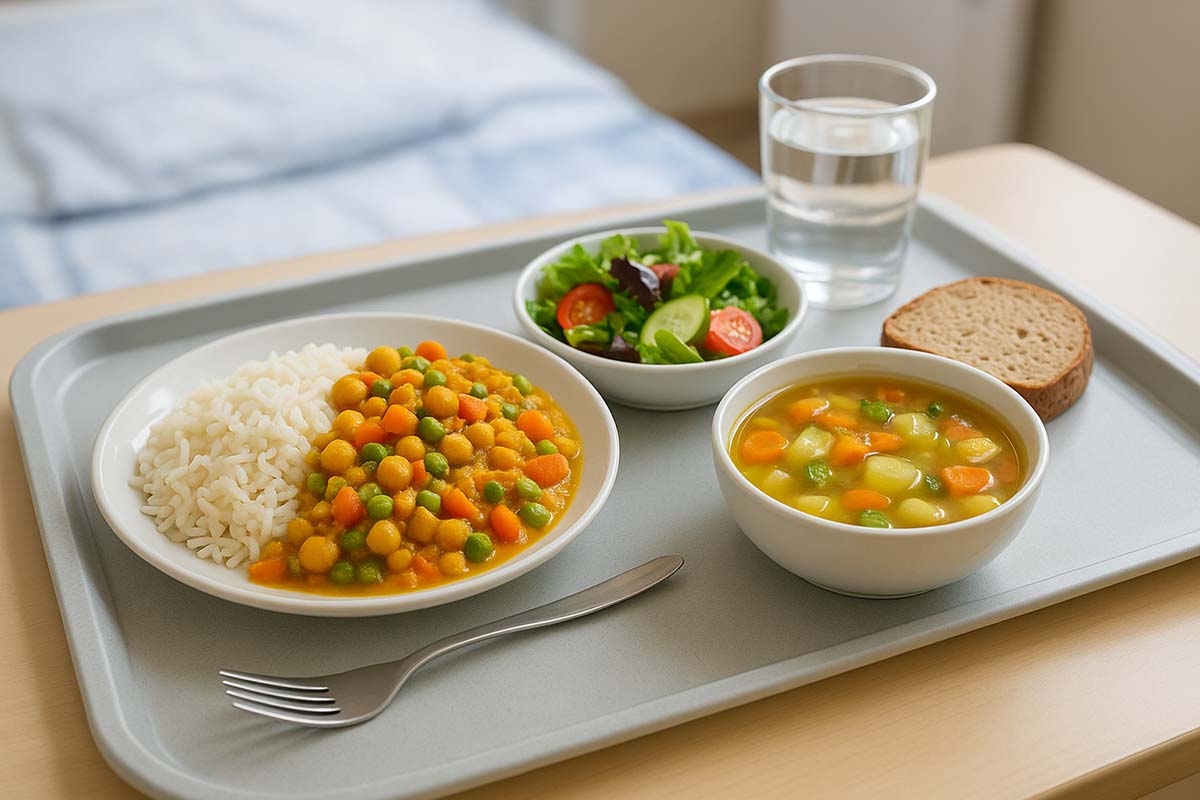
Plant-based meals in hospitals: what is the situation in practice?
Experience shows that larger hospitals with diet kitchens are generally able to provide plant-based meals if there is a demand for them. The difficulty lies more in organization, labor shortages, and capacity than in legislation. NÉGYOSZ plans to start negotiations with hospitals in order to make the practical introduction of plant-based diets possible in as many places as possible.
What can patients do if the hospital does not provide plant-based meals?
Under the Fundamental Law, everyone has the right to live according to their worldview, conscience, and moral convictions—and this includes their choice of diet. The right to health is also a fundamental right, which covers not only existing illnesses but also prevention, so everyone has the right to follow the diet that seems healthiest for them – which may be a plant-based diet. A patient’s right to eat according to their own chosen diet cannot be infringed upon, even if the hospital is unable to provide it. In such cases, it is possible to consume food from an external source, for example, brought from home with the help of relatives or provided by a food delivery company, naturally in compliance with the hospital’s hygiene regulations and current patient visiting rules.
This is not the goal, but it is a significant step
Amending the public catering regulation is not yet the goal, but only one of the first steps. It is true, however, that it is a significant step for those who follow a plant-based diet.
Providing plant-based diets in hospitals from February 2025:
- mandatory on medical advice,
- permitted for lifestyle or ethical reasons if the institution and the service provider agree,
- and patients have the right to eat according to their own diet, even if it is provided from an external source.
The goal of NÉGYOSZ is to ensure that the possibilities provided by the law are realized in practice, so that patients who choose a plant-based diet receive healthy meals that are suitable for them in every hospital.
If you agree with the goals of our efforts and have not yet signed our Manifesto, you can do so by clicking on the link!