Plant-based or animal-based? VAT matters
Hungary has the largest VAT gap between plant-based and animal-based foods
Building more sustainable food systems is an increasingly prominent policy goal in Europe. In this context, a particularly timely question is how tax systems treat animal-based foods and their plant-based alternatives. A new report by the European Vegetarian Union (EVU) compares VAT rates across EU Member States and examines how large the gap is in each country between the taxation of the two product groups. According to the comparison, the gap is largest in Hungary.
A broad body of environmental and nutrition research, including the work of the EAT–Lancet Commission, shows that more sustainable dietary patterns than today’s will be needed in the coming decades to address public health, environmental and climate challenges.
In line with this, plant-based foods and protein sources are given greater emphasis in the national dietary guidelines of many European countries. One possible way to support this shift is to encourage the cultivation and consumption of legumes. Another is to examine whether the regulatory and fiscal environment adequately supports consumer choice between animal-based and plant-based foods.
Hungary has a significant gap between VAT rates
The EVU report examined 33 product categories, including 15 directly comparable product pairs. In 15 Member States, all the foods examined fall under the same VAT rate. In 12 Member States, however, at least one plant-based product is taxed at a higher rate than its animal-based counterpart. The report did not find the reverse in any Member State.
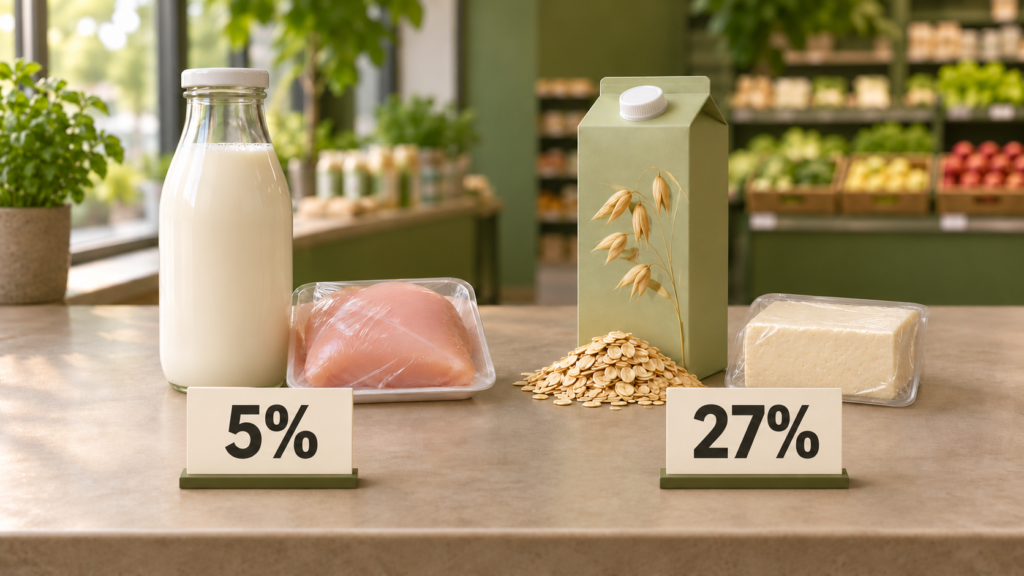
In Hungary, all the plant-based foods examined fall under the standard VAT rate of 27%. These include plant-based drinks, some plant-based meat and fish alternatives, as well as tofu, tempeh and seitan. By contrast, a reduced rate of 5% applies to several animal-based staple foods, such as milk and certain meat and fish products. Plant-based dairy alternatives are generally taxed at 27%, while several dairy products fall under the 18% rate.
The difference is also reflected in consumer prices. At the same net price of HUF 100, the gross price of a product taxed at 27% is HUF 127, compared with HUF 105 at 5% VAT. This is a difference of HUF 22, meaning that in this example the gross price of the product with the higher VAT is about 21% higher.
The difference in taxation may also affect competitiveness. It affects companies producing plant-based foods, including many Hungarian SMEs, as well as the farmers who supply them with raw materials. At the same time, growing European demand for plant proteins could open new market opportunities for Hungarian agriculture and the food industry.
There are already examples of equal tax treatment in Europe
According to the EVU report, the tax systems of several European countries treat animal-based products and their plant-based alternatives in the same or a very similar way.
In Czechia, since 1 January 2024, milk, liquid dairy products and their plant-based alternatives have all fallen under the reduced VAT rate of 12%. The rule also covers soy, almond, rice and oat drinks, among others. Portugal in 2023 and Belgium in 2025 aligned the VAT on plant-based drinks with that on cow’s milk.
These examples show that reduced VAT rates for plant-based alternatives can be introduced within the framework of EU VAT rules.
The Hungarian Association of Plant-Based Food Producers and Distributors (NÉGYOSZ) therefore considers it justified to examine whether the tax conditions for animal-based and plant-based products that meet the same consumer needs could be brought closer together in Hungary as well.
“From a tax perspective, there are European examples that show change is possible. We hope that a dialogue can begin in Hungary too on how to design VAT rules that take into account consumer interests, food security and the competitiveness of the domestic food industry at the same time. The importance of plant proteins is expected to keep growing, while sustainability and health awareness are playing an increasingly important role in the purchasing decisions of younger generations of consumers. It could therefore also be an economic opportunity for the Hungarian food industry if we can meet these new consumer needs as much as possible from domestic production,” said István Miskolczi, Managing Director of NÉGYOSZ.
The data in the report reflect the rates in force between March and August 2026. The full report is available in English: https://www.euroveg.eu/vat-2026/